


Different concentrations of nivolumab reduce PD-1 expression but not tumour growth in an EMT6 mouse model

- Faculty of Medicine, Universiti Teknologi MARA, Jalan Hospital, 47000 Sungai Buloh, Selangor, Malaysia
- Faculty of Dentistry, Universiti Teknologi MARA, Sungai Buloh, Selangor, Malaysia
- Faculty of Science, Universiti Putra Malaysia, 43400 Serdang, Selangor, Malaysia
Abstract
Introduction: The interaction between the T cell immune checkpoint proteins, the programmed death-1 (PD-1) receptor, and its ligand PD-L1 plays a crucial role in T cell suppression and the evasion of cancer cells from immune detection, thereby promoting tumour growth. Nivolumab, a PD-1 inhibitor, disrupts this interaction, offering a potential therapeutic anti-cancer strategy. The goals of this study were to identify the optimal dosage of nivolumab that effectively decreases PD-1 protein expression in a mouse model, and to examine the impact on tumour growth.
Methods: We utilized a xenograft mouse model with EMT6 mammary carcinoma cells. Eight female Balb/C mice were inoculated with EMT6 cells and assigned to three groups: a control (n = 2) and two treatment groups receiving nivolumab at 5 mg/kg (n = 3) and 10 mg/kg (n = 3) on days 10, 12, and 14 postinoculation. Tumour sizes were measured at specified intervals using electronic callipers, and the mice were sacrificed on day 16 to assess PD-1 protein levels via sandwich ELISA.
Results: There was no significant difference in tumour volume across all groups compared to the controls. PD-1 protein expression was significantly lower in Group 3 (10 mg/kg nivolumab) than in both Group 2 and the control group.
Conclusion: Nivolumab administration at a dose of 10 mg/kg markedly reduced PD-1 protein expression in a tumour-bearing mouse model, suggesting that higher doses of nivolumab may be more effective in modulating immune responses against tumour growth. These findings contribute to our understanding of nivolumab's pharmacodynamics and underscore the importance of dose optimization in enhancing the therapeutic efficacy of the drug against cancer.
INTRODUCTION
Immune checkpoints are crucial in regulating the balance of activities involved in the immune response. The PD-1 receptor and its ligand, PD-L1, are immune T-cell checkpoints controlling the activation and maintenance of immune tolerance within the tumour microenvironment. The PD-1/PD-L1 signalling pathway prevents the activation of effector T lymphocytes, thus enhancing the immunological tolerance of tumour cells and ultimately leading to immune escape1.
As a consequence, tumour cells continue to proliferate and spread by evading detection and attack from the immune system2. The PD-1 protein is expressed by immune cells, including peripherally activated T- and B-cells, macrophages, and some dendritic cells3. The PD-1 receptors include PD-L1 and PD-L2. Both receptors are expressed in antigen-presenting cells (APC), including dendritic cells, macrophages and B cells4. PD-L1 also has been reported in tumour cells5. The activation of the PD-1 signalling pathway leads to decreased T cell proliferation and the production of cytokines such as IFN-γ, tumour necrosis factor-α, and interleukin-2 (IL-2), and thus affects cell survival6.
PD-1 regulates the activation of immune checkpoints by binding to its ligand PD-L1 and subsequently triggers an intracellular signalling cascade that halts the activation of the immune response, thereby regulating the release of cytokines by immune cells2. The binding of PD-1 with PD-L1 at the tumour surface in tumour infiltration lymphocytes has been proposed as the cause of the loss of lymphocyte function that consequently allows the tumour to escape the action of the immune system.
PD-1 and PD-L1 are also expressed at abnormally high levels by several forms of tumours such as lymphocytic leukaemia7, oral squamous carcinoma8, nasopharyngeal carcinoma9, breast cancer10, and melanoma and lung cancer2, indicating that these proteins are the primary components involved in enhancing the capacity of tumour immune escape8, 9, 10, 11. Thus, it is unclear whether PD-1 exerts a positive or negative effect in either eliminating the destructive immune responses or encouraging the proliferation of cancer cells through inhibition or exhaustion of tumour immunity5. Data on the antagonistic therapeutic impact of PD-1/PD-L1 on solid tumours are currently limited. Despite a 40 to 50% effectiveness of anti-PD-L1 antagonists, both anti-PD-1 and anti-PD-L1 medications have shown extremely poor efficacy against metastatic melanoma, lung, and colorectal cancers12. The poor treatment response may be linked to the complex involvement of the tumour microenvironment in the development and metastasis of cancer as well as the degree of genetic variation among patients2.
Radiation therapy stimulates a variety of immune cells to infiltrate the tumour microenvironment and promote antitumor responses13, 14, 15, 16 Nevertheless, immune escape has the opposite effect, allowing for tumour relapse17. Cytokines and tumour-derived exosomes in the tumour microenvironment can stimulate PD-L1 expression and promote tumour immune suppression2. Combining conventional radiation with anti-PD-1 demonstrated significant antitumor immunity in small-cell lung cancer18. The United States Food and Drug Administration (FDA) has currently approved the usage of several PD-1/PD-L1 inhibitors for cancer immunotherapy, including nivolumab, pembrolizumab, cemiplimab, atezolizumab, durvalumab, and avelumab, for the treatment of various types of solid tumours19, 20.
Our group has successfully developed an acquired gamma-ray radioresistant model, i.e., an EMT6 mouse-bearing mammary carcinoma using fractionated irradiation at 2 Gy / cycle. The development of radioresistant EMT6 cells occurred through the STAT/ AKT pathway via overexpression of the PD-1 protein. The current study investigated the effect of gamma-ray radiation combined with a PD-1 inhibitor (nivolumab) on the proliferation of radioresistant EMT6 cells in a mouse mammary carcinoma model. Nivolumab has been extensively studied for the treatment of glioblastoma21, adenocarcinoma22, and triple-negative breast cancer23. Nivolumab inhibited the binding of PDL-1 and PDL-2 to receptors in non-small-cell lung cancer (NSCLC) and renal cell carcinoma patients24.
MATERIALS AND METHODS
Cell Line
EMT6 (American Type Culture Collection, USA) is an epithelial cell line isolated from the breast of a mouse with a mammary tumour. The cells were cultured in Dulbecco’s Modified Eagle Medium (ThermoFisher Scientific, USA) supplemented with 10% fetal bovine serum, 100 µg/ml streptomycin, and 100 U/ml penicillin (CELLGRO Mediatech, USA) at 37°C in a humidified incubator with a 5% CO atmosphere. The cells were subcultured after reaching about 80% confluence. The cells used in the assays were maintained at least at the fourth passage.
Nivolumab
Nivolumab (MedChem Express, New Jersey) is a monoclonal antibody that inhibits the binding of PD-1 with its ligand PD-L1. A stock solution (10 mg/ml) was diluted accordingly with phosphate-buffered saline (PBS) to 5 mg/kg and 10 mg/kg before use.
Mouse tumour model
Ten-week-old female Balb/C mice were purchased from the Laboratory Animal Facility and Management (LAFAM), UiTM, and housed at the Laboratory Animal Care Unit, UiTM. The handling of mice was in accordance with protocols approved by LAFAM. The mouse tumour model was prepared according to Ibrahim et al. (2016)25. The left hind leg of a Balb/C mouse was shaved before inoculation with 1 x 10 EMT cells. The primary tumour was collected 15 days post-inoculation and processed for further investigation. All procedures were performed in accordance with Research Animal Ethic Committee UiTM (UITM CARE: 316/2020) guidelines.

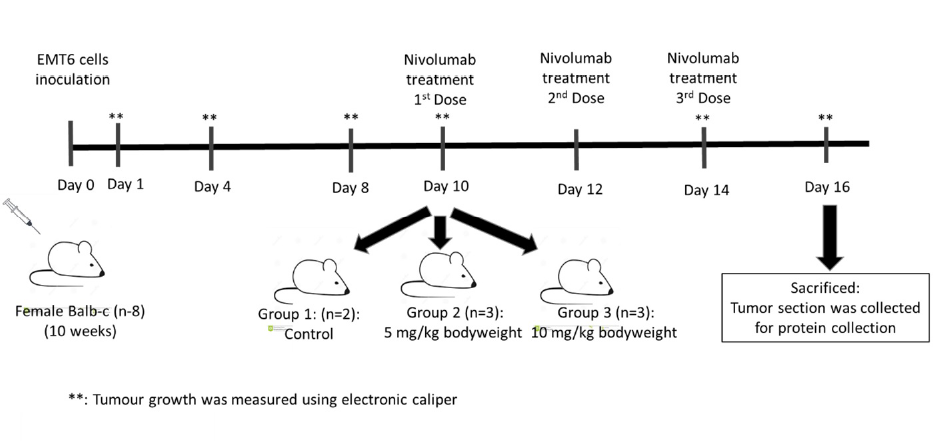
Flowchart of study protocol of treatment of Nivolumab on EMT6 mouse-bearing tumour model.

Figures showed the effect of two different doses of nivolumab on tumour growth and the control group. No significant difference was observed in tumour volume compared to the control group however, there was a trend where a 10 mg/kg dose of Nivolumab showed a decrease in tumour growth on Day 14 and Day 16 post-inoculation. (Data = mean ± s.d)

Figures showed the effect of two different doses of nivolumab on PD-1 levels compared to control. The bar graph showed that 10 mg/kg has significantly reduced PD-1 levels compared to the control group and group 1 (5 mg/kg). (# = p<0.05) (Data = mean ± s.d)
Protein concentrations extracted from tumour section
|
Group |
Reading 1 |
Reading 2 |
Reading 3 |
Average concentration |
Mean ± s.d |
|
Control |
195.74 |
186.3 |
203.72 |
195.25 | |
|
Group 1 (5 mg/kg) |
185.8 |
190.8 |
263.55 |
213.38 |
213.38±43.52 |
|
Group 2 (10 mg/kg) |
81.8 |
70.55 |
82.05 |
78.13 |
78.13±6.57 |
Nivolumab treatment and protein collection
Eight healthy, ten-week-old female Balb/C mice weighing approximately 18 to 22 grams were divided into three groups. Group 1 served as a control, while groups 2 and 3 were intravenously treated with nivolumab at 10 mg/kg and 5 mg/kg, respectively. The first dose of nivolumab was administered through the tail after the tumours were palpable or visible, which was approximately 10 days post-inoculation, and was followed by two additional doses on days 12 and 14. Nivolumab administration was based on a previous study26 with modification. The width and length of tumours were measured on days 1, 4, 8, 10, 14 and 16 post-inoculation using an electronic calliper. Tumours were harvested on day 16 post-inoculation and immediately weighed. End-point tumours were placed immediately in radioimmunoprecipitation assay (RIPA) buffer (ThermoFisher Scientific, USA) supplemented with protease inhibitor and stored at -80°C. The flowchart of the study design is summarized in Figure 1.
PD-1 protein extraction and measurement
The PD-1 protein was quantitatively measured using an Enzyme Linked-Immunosorbent Assay (ELISA) kit according to the manufacturer’s instructions (Bioassay Technology Laboratory, UK). The samples were washed with ice-cold PBS three or four times and agitated for two hours at 4°C. The supernatant was collected after centrifugation at 13,000 × g for 20 minutes. A 50 µL aliquot of each standard and sample was added into designated 96-microtiter wells (ThermoFisher Scientific, USA). The same volume of working solution was added and incubated for 45 minutes at 37°C. Then, 100 µL of HRP conjugate working solution was added and incubated for 30 minutes at 37°C. After that, 90 μL of the substrate reagent was added before a final incubation of 15 minutes at 37°C in the dark. The absorbance was read at 450 nm using a microplate reader after the addition of 50 μL of stop solution.
Statistical analysis
Statistical analysis was performed using GraphPad Prism 8.0. Data are presented as the mean and standard error. A non-parametric, unpaired t-test was performed for comparison between two groups, with the significance level set as P < 0.05.
RESULTS
Effect of different doses of Nivolumab on tumour growth
Tumour growth in mice inoculated with EMT6 cells was monitored by measuring the width and length of the tumours from day 1 to 16 post-inoculation. Beginning on day 10 after tumour inoculation, 0.2 mg (equivalent to 10 mg/kg) and 0.1 mg (equivalent to 5 mg/kg) of Nivolumab were injected intravenously through the tail vein using three doses, each given two days apart. The tumours developed gradually in both groups before the mice were sacrificed, and no significant difference was observed between the two doses of Nivolumab. Nonetheless, there was a trend showing that a 10 mg/kg dose of Nivolumab decreased tumour growth on Day 14 and Day 16 post-inoculation compared to a 5 mg/kg dose of Nivolumab. This suggested that 10 mg/kg may potentially affect tumour growth (Figure 2 ).
Protein concentration extracted from tumour section
Table 1 shows the protein concentration extracted from tumour sections in each group of mice. Group 2 which was injected with 10 mg/kg nivolumab showed the lowest protein concentration.
Effect of different doses of Nivolumab on PD-1 levels
The expression of the PD-1 protein in the tumours was characterized using the ELISA technique. Figure 3 shows the expression of PD-1 observed in tumours treated with 10 mg/kg and 5 mg/kg of nivolumab. The relative expression of PD-1 in mice given a 10 mg/kg dose of nivolumab decreased significantly compared to the control and 5 mg/kg dose groups (P < 0.05). This suggested that a 10 mg/kg dose of nivolumab could significantly reduce PD-1 expression.
DISCUSSION
In the present study, we analysed the effect of different concentrations of nivolumab on PD-1 protein expression on tumour growth. There are many mouse models that have been employed to study the development of cancer in the preclinical stage, including syngeneic mice, genetically modified mice, human xenograft mice, and patient xenograft humanized mice27. In this research, we used syngeneic Balb/C mice that were injected with EMT6 mouse mammary cancer, cells that have undergone numerous immunological alterations in the tumour microenvironment28, 29.
In this study, we introduced the nivolumab at three different time points on days 10, 12 and 14 post-inoculation, similar to other studies, although the type of cells, the type of anti-PD-1, and the dose chosen were different30, 31. Mathios et al. (2016)30 and Wu et al. (2019)31 exposed C57BL/6J mice to a PD-1 inhibitor on days 10, 12 and 14 after implantation of GL261 Luc cells. Additionally, other studies have introduced PD-1 inhibitors at three time points but on different days post-inoculation32, 33. A previous study introduced anti-PD-1 drugs at 5, 10 and 15 days after intracranial tumour inoculation of GL261 cells34. Another study treated mice with a PD-1 inhibitor on days 3, 6, and 9 after inoculation with GL261 cells. A study by Christine (2023) treated transgenic C57BL/6-h. PD-1 mice implanted with MC38 colon cancer using six doses of nivolumab given on days 0, 3, 6, 9, 12, and 15 post-inoculation35.
We observed that nivolumab treatment at a dose of 10 mg/kg resulted in less tumour growth than the control and 5 mg/kg groups, albeit this difference was not statistically significant. Only on day 14, two days after the first dosage of nivolumab, did the rate of tumour growth in Group 2 begin to decline. In the past, tumour ablation was observed in adenocarcinoma xenograft mice that received PD-1 monotherapy injections on days 7, 10, and 13. Nevertheless, this study tracked the tumour progression for 33 days22. This shows that nivolumab can slow tumour growth over a longer time of observation. This conclusion was also supported by the study of Reardon showing that the administration of a PD-1 blocker in an advanced intracranial glioblastoma tumour mouse model resulted in the mice remaining alive without evidence of tumour at more than 100 days after tumour implantation21.
To further investigate PD-1 activity, we measured the expression in the tumour microenvironment using ELISA after the mice were treated with nivolumab. In this case, Group 2 mice treated with 10 mg/kg nivolumab exhibited a significantly lower level of PD-1 than the 5 mg/kg nivolumab and control groups. Similarly, a study by Selby et al. found that when administering an anti-PD-1 monoclonal antibody (nivolumab) at 10 mg/kg, the addition of anti-CTLA-4 at a lower dose resulted in anti-tumour activity36. The latter study also observed that using anti-PD-1 as a single drug resulted in T-cell infiltration into tumours in MC38 and CT26 mouse colorectal tumour models36, suggesting that PD-1 was successfully blocked. Another study found that anti-PD-1 monotherapy, which prevented PD-1 interactions, caused small increases in CD8+ T cells in tumours that were responsive to the treatment37 and showed that IL-13 levels were also elevated with PD-1 treatment, supporting the hypothesis that IL-13 plays a role in anti-tumour activity37, 38.
CONCLUSION
This study showed that nivolumab at a dose of 10 mg/kg influenced tumour growth and PD-1 activity. However, this has only been found in a syngeneic tumour model. Further study is needed using non-responsive models.
Abbreviations
PD-1: Programmed Death-1, PD-L1: Programmed Death-Ligand 1, EMT6: Epithelial-Mesenchymal Transition 6, ELISA: Enzyme Linked-Immunosorbent Assay, APC: Antigen-Presenting Cells, IFN-γ: Interferon-gammaI, L-2: Interleukin-2, NSCLC: Non-Small Cell Lung Cancer, FDA: Food and Drug Administration, RIPA: Radioimmunoprecipitation Assay, PBS: Phosphate-Buffered Saline, LAFAM: Laboratory Animal Facility and Management, UiTM: Universiti Teknologi MARA, STAT: Signal Transducer and Activator of Transcription, AKT: Protein Kinase, BGL261 Luc cells: GL261 Luciferase cells, C57BL/6J mice: C57 Black 6 Jackson mice, MC38: Mouse Colon 38, CTLA-4: Cytotoxic T-Lymphocyte Antigen 4
Acknowledgments
The authors express their gratitude to the funders, Ministry of Higher Education Malaysia and Universiti Teknologi MARA for their support.
Author’s contributions
Funding acquisition: MJI, NAH, HHH; Conception: NRFS, MJI; Methodology: NFRS, NAH, MJI; Interpretation or analysis of data: NRFS, NAHH, MJI; Preparation of the manuscript: NH, NAHH, NH, MKAK, SBSAF, SO, NJO, MJI; Revision for important intellectual content: NFRS, HHH, NAHH, SO, NJO, SBSAF, EO, MJI; Supervision: NAHH, HHH, MKAK, MJI. All authors read and approved the final manuscript.
Funding
The study was partly funded by Fundamental Research Grant Scheme, Ministry of Education Malaysia (FRGS/1/2019/SKK08/UITM/02/9) and Lestari Research Grant, Universiti Teknologi MARA (600-RMC/MYRA 5/3/LESTARI (094/2020)).
Availability of data and materials
Data and materials used and/or analyzed during the current study are available from the corresponding author on reasonable request.
Ethics approval
All procedures were performed in accordance with Research Animal Ethic Committee UiTM (UITM CARE: 316/2020) guidelines.
Consent for publication
Not applicable.
Competing interests
The authors declare that they have no competing interests.